Uber Eats auto-entrepreneur in France: sign-up, URSSAF
To deliver on your own account, becoming an Uber Eats auto-entrepreneur (a self-employed person under France’s micro-business regime) is the simplest route: Uber Eats asks for proof that your business exists, and registering a micro-entreprise (France’s micro-business regime) on the guichet unique (the one-stop business formalities portal, run by INPI) is free. You then pay contributions proportional to your turnover, and nothing when it is zero.
The rules are those published by Uber Eats and Service-Public, checked on 21 October 2026.
Do you need to be an auto-entrepreneur to deliver with Uber Eats?
Not strictly, but almost always in practice: Uber Eats describes its couriers as self-employed people, with the auto-entrepreneur as its example, or as employees of a delivery company that manages a fleet. Uber’s page on how the Uber Eats app works sets out these two routes.
Delivering on your own account therefore means setting up your micro-entreprise; micro-entrepreneur is the official name of the auto-entrepreneur. The other steps of setting up are gathered in Set up, combine, close.
Delivering without registration is not an option. The Service-Public page “Formalités d’immatriculation d’une micro-entreprise” (registration formalities for a micro-entreprise) states that carrying on a commercial, craft or professional activity without being registered in the RNE (the national business register) is punished by a €7,500 fine.
Carrying passengers is a different trade: a VTC auto-entrepreneur passes an exam and registers on the VTC operators’ register before their first ride.
What are the requirements to deliver with Uber Eats?
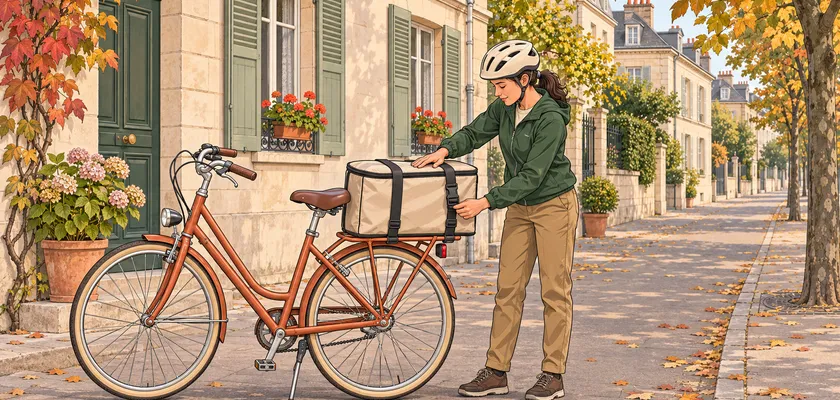
Uber Eats asks for three validated documents before your first delivery, a bicycle or an electric-assist bicycle and an insulated bag that meets the standards. Uber Eats’s page “Avant de commencer” (before you start) lists these requirements:
- proof that your business exists (une preuve de l’existence de ton entreprise);
- a profile photo;
- a valid identity document;
- a bicycle or an electric-assist bicycle (VAE), which except in special cases are the only vehicles allowed on Uber Eats;
- an insulated delivery bag that meets the standards.
The same page states that your account is “strictly personal”. If you are a foreign national, Uber Eats’s page “Étapes pour devenir coursier” (steps to become a courier) accepts French residence permits that allow you to set up an auto-entreprise.
Age depends on the law, not on Uber Eats. According to the Service-Public page on setting up a business as a minor, a minor who has not been emancipated cannot set up a micro-entreprise, whereas an emancipated minor can be a micro-entrepreneur.
How do you set up your delivery micro-entreprise for free?
You declare your activity online on the guichet unique, at the earliest 1 month before you start and at the latest 15 days after, and registering a micro-entreprise is free. The deadlines are Service-Public’s; the free registration, “except for commercial agents” (à l’exception des agents commerciaux), appears in the page “Comment devenir micro-entrepreneur ?” (how to become a micro-entrepreneur). The guichet unique is run by INPI (the national industrial property office).
- Prepare the three documents Service-Public lists: proof of the business’s address (a water, electricity or gas bill, for example), a signed and dated sworn statement of no criminal conviction with a statement of parentage, and a copy of your identity document.
- Submit your application on the guichet unique.
- Keep your receipt marked “En attente d’immatriculation” (awaiting registration): it lets you take the first steps, such as taking out insurance, and is valid for 1 month at most.
- Receive your proof of registration: according to Service-Public, it carries your micro-entreprise’s numbers, including the SIREN (the nine-digit business number) and the APE code (the activity code).
- Get your SIRET without asking for anything: the page “Comment obtenir un numéro Siren ou un Siret ?” (how to get a SIREN or SIRET number) states that the numbers arrive automatically as soon as the registration application is accepted. The article on the SIRET number explains where to find it again.
Which APE code for a courier?
Your APE code is assigned automatically by INSEE (the national statistics institute) at registration: you do not choose it. The Service-Public page “À quoi correspond le code APE ?” (what the APE code is) adds that it has no legal value and cannot be used to justify the application of certain rights.
In the INSEE nomenclature, subclass 53.20Z includes “home delivery services” and “the activities of urban couriers”. That is the class of the activity, with no promise about your code. If your code is wrong, you report it to INSEE; a change of main activity goes through the guichet unique, according to Service-Public.
According to Service-Public, every business’s APE code will change on 1 January 2027 under the new NAF 2025. The number 53.20Z will therefore change too.
Which document do you show Uber Eats: Kbis, extrait K or Sirene notice?
Uber Eats accepts a Kbis extract or your avis de situation au répertoire Sirene (Sirene notice) as proof that your business exists. Once your micro-entreprise is registered, you can download the Sirene notice online and, depending on your activity, an extrait K (the register extract of a sole trader on the RCS) or a justificatif d’immatriculation au RNE (proof of registration in the RNE). Uber Eats’s “Étapes pour devenir coursier” page says “extrait KBIS ou l’avis de situation au repertoire SIRENE”, and its FAQ points to the site avis-situation-sirene.insee.fr for the notice.
A Kbis is a company’s document: for a sole proprietorship (entreprise individuelle, EI), the Service-Public page “Comment obtenir un extrait K ou Kbis ?” (how to get an extrait K or Kbis) talks about the extrait K, which proves registration in the RCS and is available free online, and presents the justificatif d’immatriculation au RNE as its free equivalent. The article on the Kbis for an auto-entrepreneur details which one you get, and the one on the Sirene notice how to download it.
Register your micro-entreprise first, and sign up on Uber Eats once you have your SIRET: your proof of existence is then ready.
How much do you pay the URSSAF and what do you declare?
Your contributions are a fixed percentage of your turnover, 21.2% in 2026 for a BIC (industrial and commercial profits) service activity, and nothing when turnover is €0. These figures come from the Service-Public page “Cotisations sociales d’un micro-entrepreneur : ce qu’il faut savoir” (a micro-entrepreneur’s social-security contributions: what to know); the category your activity falls into is confirmed on autoentrepreneur.urssaf.fr.
| What you pay | When | 2026 figure |
|---|---|---|
| Social-security contributions | every month or every quarter | 21.2% of turnover (BIC service activity) |
| Income tax | once a year, on the 2042-C-PRO | on 50% of turnover, minimum allowance €305 |
| Versement libératoire (option) | with the contributions | 22.9% in total, contributions included |
| CFE | every year, except the year of creation | exempt in the first year, base halved in the second |
The URSSAF turnover declaration is made online, every month or every quarter, and the first one at the earliest 3 months (90 days) after the activity starts, according to Service-Public.
Uber Eats now collects your contributions. According to the Service-Public news item of 20 October 2025, updated on 15 September 2026, Uber Eats is among the voluntary platforms that calculate and collect auto-entrepreneurs’ contributions from October 2026. The platform also declares your turnover to the URSSAF every month, even if you chose quarterly declaration. On 1 January 2027, all digital platforms will have to do so.
Income tax remains your own declaration. Uber Eats’s page “Les obligations des livreurs Uber Eats en matière de TVA” (Uber Eats couriers’ VAT obligations) states that the monthly tax summary it provides is not an official tax document but can help you prepare your return, and that tips are income subject to tax.
The micro tax regime applies in 2026 if your 2025 or 2024 turnover did not exceed €83,600, according to the Service-Public page “Régime fiscal de la micro-entreprise” (tax regime of the micro-entreprise) for a BIC service activity. Tax is then charged on your turnover after a 50% allowance, at least €305, declared on the 2042-C-PRO; with the versement libératoire, the URSSAF collects the tax with your contributions, 22.9% in total according to Service-Public’s page on contributions.
Three rules complete the picture. The ACRE (start-up relief on contributions) brings contributions down to 75% of the normal rate for the first quarters, but is not automatic and depends on your situation. The CFE (the local business property tax) is not due in the year of creation, and its base is halved the following year. Finally, Service-Public states that the micro social regime ends if the micro tax regime’s ceiling is exceeded two years in a row.
Insurance, VAT, bank account: what is compulsory?
A bank account is compulsory from the start, according to Service-Public’s page on the micro-entreprise tax regime, and must be a dedicated one beyond a certain turnover. A delivery auto-entrepreneur has no general insurance obligation, apart from insuring the vehicle used for work, according to Service-Public, and up to €37,500 of turnover last year and €41,250 this year you remain under the franchise en base de TVA (the VAT exemption for small businesses).
| Obligation | Compulsory? | Condition |
|---|---|---|
| Bank account | yes | dedicated to the business beyond a certain turnover |
| Insurance | for the work vehicle, yes according to Service-Public | otherwise recommended; also compulsory for a regulated activity |
| VAT | no | franchise up to €37,500 last year and €41,250 in the current year |
The Service-Public page “Un micro-entrepreneur doit-il être obligatoirement assuré ?” (must a micro-entrepreneur be insured?), checked on 22 September 2023, requires insurance for a regulated activity and for a vehicle used in your professional activity, and recommends it in other cases. Service-Public also warns, in its page on insuring a vehicle used for work, that your insurer does not always automatically cover the bicycle you use for work.
On its page “Avantages” (perks), Uber Eats announces free health and protection cover with AXA. The Code du travail (labour code) adds that, if you take out work-accident insurance, the platform that sets the price of the service pays your contribution, up to a ceiling set by decree and above a turnover threshold (art. L. 7342-1, L. 7342-2 and L. 7342-4).
Within the VAT thresholds in the Service-Public page “Franchise en base de TVA” for a service activity, you do not declare VAT and do not recover it on your purchases. Uber Eats’s tax page repeats these two figures and asks you to select the option “régime des petites entreprises ou auto-entrepreneur” (small-business or auto-entrepreneur regime).
To track your payouts and expenses, BravoLisa’s free plan records your income and expenses, and Lisa reads your receipts.
Can you deliver for several platforms?
Yes: Uber Eats imposes no exclusivity, and you can accept or refuse each delivery request. Uber’s page on the app states that its couriers “are not bound by any exclusivity obligation” (ne sont tenus à aucune obligation d’exclusivité). The Code du travail also provides that a self-employed worker may use one or several matching platforms (art. L. 7341-1).
On 1 January 2027, each platform will collect contributions on the turnover made through it, according to Service-Public; until then, for a platform that does not yet collect them, you declare that turnover yourself online, every month or every quarter.
Frequently asked questions
Do you need to be an auto-entrepreneur for Uber Eats?
Almost always. Uber Eats describes its couriers as self-employed people, with the auto-entrepreneur as its example, or as employees of a delivery company that manages a fleet. To deliver on your own account you therefore need a registered business: Uber Eats asks for proof that it exists before your first delivery.
How do you become an Uber Eats courier for free?
You first set up your micro-entreprise on the guichet unique: according to Service-Public, its registration is always free, except for commercial agents. Once your micro-entreprise is registered, your SIRET arrives without any step. You then open your Uber Eats account with proof that your business exists, a profile photo and a valid identity document.
Do you need a Kbis for Uber Eats?
Uber Eats asks for a Kbis extract or your avis de situation au répertoire Sirene (Sirene notice). The Kbis is the document of companies: for a sole proprietorship, Service-Public talks about the extrait K, if the activity is commercial, and a justificatif d'immatriculation au RNE (proof of registration in the RNE), its equivalent. The Sirene notice is retrieved on INSEE's site, as Uber Eats indicates.
Which APE code for an Uber Eats courier?
INSEE assigns your APE code automatically at registration: you do not choose it. In INSEE's nomenclature, subclass 53.20Z includes home delivery services and the activities of urban couriers. The code has no legal value, and according to Service-Public all APE codes change on 1 January 2027 with the NAF 2025.
Which contributions does an Uber Eats courier pay?
According to Service-Public, an auto-entrepreneur's contributions are a fixed percentage of turnover: 21.2% in 2026 for a BIC service activity, nothing if turnover is zero. Since October 2026, Uber Eats collects these contributions from your earnings itself, and all platforms will do so on 1 January 2027.