Handyman auto-entrepreneur in France in 2026
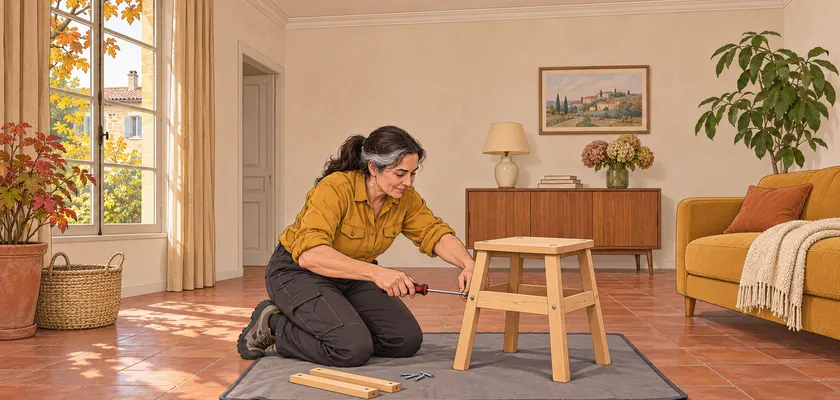
You can be a handyman auto-entrepreneur without a diploma, as long as you stay within minor DIY as the State defines it: elementary tasks, with no particular professional know-how, taking two hours at most. Rules up to date for 2026.
What is minor DIY, and what does the two-hour limit mean?
Minor DIY (petit bricolage, also called homme toutes mains, “handyman”) covers elementary, occasional tasks, requiring no particular professional know-how, that can be done in two hours at most: fixing a shelf, hanging curtains, assembling flat-pack furniture. These three traits are the ones published by the home services portal, which describes it as one of the home services activities (services à la personne).
The activity appears under this name in article D. 7231-1 of the Code du travail, among the 21 activities for which the declaration is optional. The article itself sets no duration: the two hours come from the State’s definition, and a ministerial answer published in the Sénat’s official journal on 8 March 2018 already recalled them, speaking of a “very short intervention time, which must not exceed two hours”.
No authority says what becomes of an elementary task that runs over two hours: the limit is part of the definition of the home services activity, the one that opens the tax credit for your clients. Starting out in minor DIY is an ordinary micro-entreprise set-up, whose steps are on the page Setting up, combining, closing.
What is part of it, according to the portal’s examples:
- fixing a shelf;
- hanging curtains;
- assembling small flat-pack furniture;
- installing smoke alarms or grab bars;
- replacing a seal.
What is excluded, according to the same portal:
- removal of equipment, clearing a cellar or an attic, and moving house;
- the construction, maintenance and repair of buildings, which belong to the structural work, finishing and fitting-out trades;
- the installation, maintenance and repair of fluid networks, and of gas, heating and electrical equipment;
- the sale of products or equipment.
Small supplies are an exception to the last line. The portal accepts that you buy the supplies needed for the job and that your client reimburses you at cost, but that part of the invoice does not qualify for the tax credit. Selling, for its part, stays outside minor DIY: you do not resell equipment at a margin.
Do you need a diploma, and where does a qualified trade begin?
No diploma is required for minor DIY, but building, maintaining or repairing a building and working on fluid, gas, heating or electrical installations are regulated craft activities, reserved for a qualified person. The rule is that of article L121-1 of the Code de l’artisanat: “whatever the legal status and characteristics of the business”, these activities may only be carried out by a person with professional qualifications or under their effective and permanent control.
Being an auto-entrepreneur changes nothing about this rule. The same list also reserves chimney sweeping, vehicle maintenance and repair, hairdressing and beauty care, but for a handyman it is the two lines on buildings and networks that matter. Electricity, in particular, is a qualified trade in its own right, with its own procedures, described in electrician auto-entrepreneur.
Qualification is proven in three ways, according to the Service-Public page on craftsperson status:
- a CAP or a BEP in the trade (vocational diplomas);
- a title registered in the national register of professional certifications (RNCP), of at least equivalent level;
- at least 3 years of professional experience.
Minor DIY escapes this requirement, and that is the very reason for its limits. In its 2018 answer, the ministry explains that the activity must not compete with that of craftspeople, who are “subject to qualification requirements from which entrepreneurs carrying out minor DIY work are exempt”. Elementary tasks, no particular know-how, two hours at most: that is what separates your activity from a building trade.
A short intervention on a network or a building is not minor DIY. The State’s list of exclusions targets the nature of the work, not its duration: repairing an electrical or heating installation in twenty minutes is still a regulated activity.
Practising without the qualification is costly. Article L151-2 of the Code de l’artisanat punishes with a €7,500 fine the act of practising independently an activity on the list without the required qualification or without the control of a person who has it.
No authority draws the line task by task between minor DIY and a building trade: the State publishes the list of regulated activities and that of exclusions, not a list of gestures. If a task you want to offer touches a building or a network, consider that it requires the qualification, or leave it to a qualified craftsperson.
Which status to choose: the micro-entreprise or another form?
The micro-entreprise (France’s micro-business regime) is enough to get started in most cases: you work as a sole proprietor under your own name, your contributions are a percentage of what you collect, and it is the status targeted by the 2025 home services exemption. The micro-entrepreneur, the official name of the auto-entrepreneur, falls under the micro social-security regime (régime micro-social) for contributions and the micro tax regime for income tax.
This framework suits the activity: everything is calculated on turnover, and a flat-rate allowance stands in for actual costs.
The form matters for your clients too. Since 1 January 2025, the home services portal has opened an exemption, among others, to sole proprietors under the micro-entreprise regime whose main activity is home services: they may add a small ancillary activity without costing their clients their benefits, as we will see below.
The other forms come later. The actual-profit regime (régime réel), chosen or imposed when the ceilings are exceeded, and the company, when the business grows or hires, remain options; that choice goes beyond this page, which assumes a micro-entreprise.
How do you register, with which wording and which APE code?
You register online on the INPI’s guichet unique (the one-stop business formalities portal), describing your services in the State’s terms; the INSEE then assigns you an APE code (the activity code), which has no legal value. According to the Service-Public page on registering a micro-entreprise, the formalities are free in most cases; only commercial agents pay for their registration, €23.21.
The steps, following the Service-Public page on creating a micro-entreprise for the first, third and fourth:
- Check that the planned activity is not regulated: Service-Public insists on this prior check, and minor DIY is not regulated as long as it stays within its definition.
- Describe your services as the State describes them, which is our advice: elementary and occasional minor DIY work, with no particular professional know-how, lasting two hours at most.
- File the declaration on the guichet unique, with a copy of the diploma if you add a regulated activity.
- Receive your proof of registration on the RNE (the national business register), with your SIREN and your APE code; your SIRET is assigned at the same time.
The SIRET, your establishment number, follows the SIREN on your invoices; SIRET number explains where to find it and what it is for. No authority says whether minor DIY is declared as a craft or a commercial activity at the guichet: describe your tasks faithfully, in the terms of step 2.
The APE code is not your choice. The Service-Public page on the APE code states that it is “assigned automatically by the INSEE on registration”, based on your main activity, the one with the most turnover if you have several. The same page adds that it “has no legal value”: it neither gives you nor takes away any right.
No authority publishes “the” APE code for minor DIY. The INSEE files the services of “hommes toutes mains” in a product class attached to code 81.21Z, “Nettoyage courant des bâtiments” (routine cleaning of buildings), until 31 December 2026. It is a statistical nomenclature, not a list of what you are allowed to do.
From 1 January 2027, all APE codes change to follow the new NAF 2025 nomenclature, according to Service-Public. Your new code can then be read on sirene.gouv.fr.
Should you declare as home services, and what do your clients gain?
The home services declaration is optional and made on NOVA (the State’s online service for home services), but without it your clients are not entitled to the 50% tax credit, capped for minor DIY at €500 of spending per year and per household. The home services portal says so plainly: undeclared organisations and their clients do not benefit from the tax and social advantages. The BOFiP sets this cap: a client gets back at most €250 a year on your minor DIY.
Once declared, you can also work for professionals since 1 January 2025, according to the ministry’s FAQ: as an ancillary activity, at 30% at most of your turnover excluding VAT for the year, invoiced separately and with no tax credit for those clients. The declaration, the exemption and the invoice mentions are detailed in home services as an auto-entrepreneur.
What you pay: ceiling, contributions and VAT
In 2026, you pay 21.2% of your collected turnover in social contributions, you stay in the micro regime up to €83,600 a year and you do not charge VAT as long as you stay under €37,500. The rate comes from the Service-Public page on contributions, which applies it to BIC services.
| What counts in 2026 | Amount |
|---|---|
| Micro-entreprise ceiling | €83,600 of turnover |
| Social contribution rate | 21.2% of collected turnover |
| VAT exemption (franchise) | €37,500 the previous year |
| Higher threshold of the exemption | €41,250 in the current year |
| Versement libératoire | 1.7% of turnover, in addition |
The ceiling is the one for services: according to the Service-Public page on the micro tax regime, the micro tax regime applies in 2026 if your turnover for 2025 or 2024 did not exceed €83,600. Taxable income is your turnover minus a flat-rate allowance, which replaces all your costs. The same page sets the versement libératoire (paying income tax as a percentage of turnover, with the contributions) at 1.7% of turnover for BIC services: if your reference tax income allows it, it settles income tax at the same time as the contributions.
VAT arrives well before the ceiling. The Service-Public page on the VAT exemption keeps it for services as long as your turnover for the previous year stays under €37,500 and that of the current year under €41,250. Beyond that, you charge VAT, even while staying in the micro regime.
No authority names minor DIY as BIC or BNC: the category follows the nature of the work. The BOFiP recalls that article 34 of the Code général des impôts places commercial, industrial or craft professions in BIC; if your work falls under BIC services, the 21.2% rate applies. The ACRE, if you are entitled to it, brings your contributions down to 75% of the normal rate at the start of the activity; it is requested from the URSSAF.
Your contributions are calculated on what you collect, and your supplies are reimbursed to you at cost: keeping track of every payment received and every purchase avoids declaring wrongly. BravoLisa’s Free plan records your income and your expenses, from equipment to tools, and Lisa reads your receipts and your purchase invoices.
Which insurance should you take?
Professional liability insurance is compulsory only for a regulated activity; for minor DIY it remains recommended, and the ten-year guarantee targets builders bound to the client by a building works contract. The Service-Public page on a micro-entrepreneur’s insurance ties the obligation to the activity carried out, and recommends protecting yourself even without an obligation.
The ten-year guarantee (garantie décennale), according to Service-Public, is owed by the professional builder, the auto-entrepreneur included, for the construction, extension or renovation of a building. By the State’s definition, minor DIY is not construction: the construction, maintenance and repair of buildings are excluded from it. No authority settles the question for minor DIY itself; if you one day add a building trade, the ten-year guarantee comes with it.
Take professional liability insurance even without an obligation. At a private client’s home, a pipe pierced while fixing a shelf is damage that stays at your expense without it.
Frequently asked questions
Do you need a diploma to become a handyman auto-entrepreneur?
No, as long as you stay within minor DIY: elementary, occasional tasks, with no particular professional know-how, taking two hours at most. Building, maintaining and repairing buildings, and fluid, gas, heating and electrical installations, do require a CAP, a BEP, an equivalent title or 3 years of experience.
Which APE code for minor DIY?
No authority sets an APE code of its own for minor DIY. The INSEE assigns it itself at registration, based on your main activity, and files the services of « hommes toutes mains » under 81.21Z until 31 December 2026. This code has no legal value, and all APE codes change on 1 January 2027.
What is the tax reduction for minor DIY work?
The benefit is a tax credit for your client, of 50% of the sums paid. For minor DIY, their spending is counted up to €500 a year per household, so a credit of €250 at most. They are entitled to it only if your activity is declared as home services on NOVA.
Which insurance do you need for minor DIY?
According to Service-Public, professional liability insurance is compulsory only for a regulated activity, which minor DIY is not; it remains recommended. The ten-year guarantee targets builders bound to their client by a building works contract, and the State excludes such work from its definition of minor DIY.
Can a handyman auto-entrepreneur also work for professionals?
Yes. Declared as home services, you can since 1 January 2025 if minor DIY for private clients remains your main activity: work for professionals becomes an ancillary activity, limited to 30% of your turnover excluding VAT for the year, invoiced and accounted for separately, with no tax credit for those clients.